
← Business continuity and disaster recovery
SAMPLE ENGAGEMENT · FICTIONAL ORGANIZATION
What recovery looks like in practice
A regional engineering supplier loses its primary site at 10:00. See how business priorities, critical assets and a prepared recovery site help it resume order processing by 11:45.
These are illustrative planning targets and example deliverables, not measured SOS customer results or a recovery guarantee. Actual scope, data handling, capacity and acceptance criteria are agreed for your environment.
Start with the business impact
The supplier has 80 staff, a customer order application, an engineering document workspace and historical records. During the outage, staff use an approved manual intake process. The business sets a maximum tolerable interruption of four hours for order processing and a tighter two-hour recovery target so reconciliation and escalation have time to work.
A business impact analysis identifies which processes must continue, the people who approve recovery and the dependencies that must return first. Financial, customer, contractual and safety impacts are confirmed with the owners.
A sample network with a separate recovery site
The primary site serves users. A pre-provisioned warm standby at a separate failure domain receives application-consistent recovery points. Independent identity recovery, DNS, connectivity and accessible encryption keys are prerequisites. Isolated backups provide another recovery path when replicas are also corrupted.
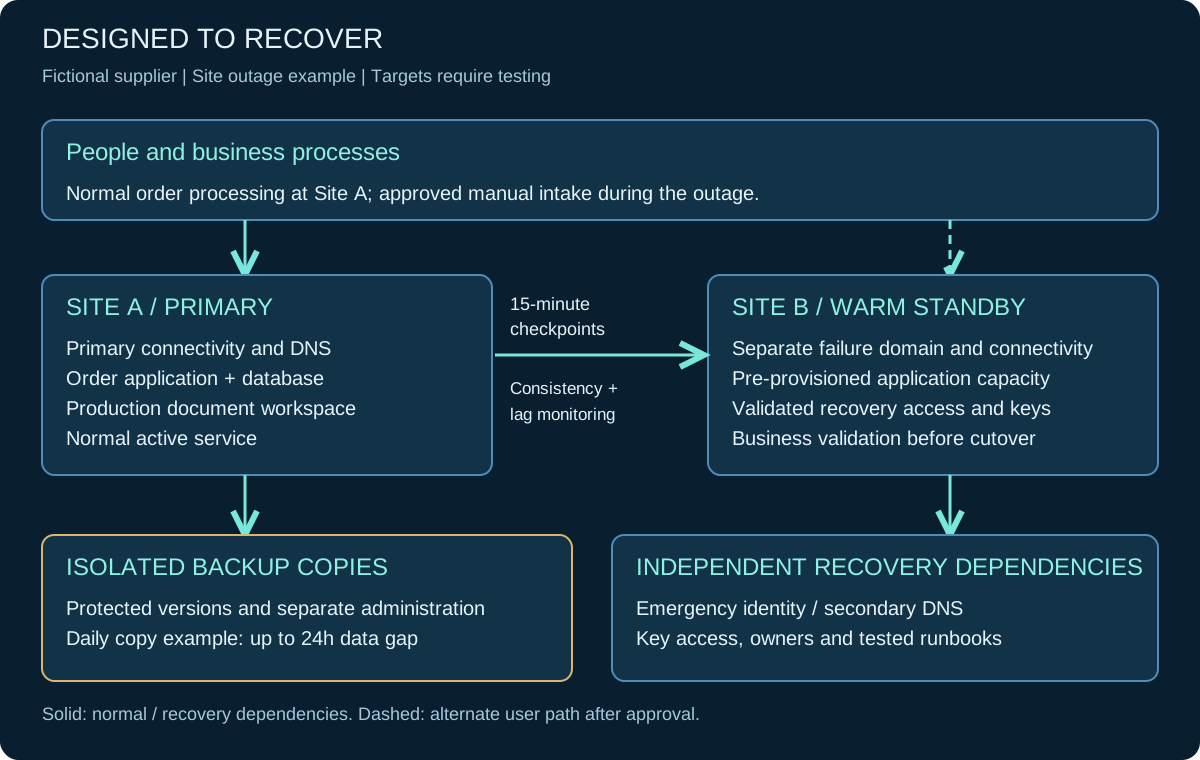
Redundancy is not a backup. Replication can carry deletion, corruption or malicious changes to the standby. Protected backup versions, restoration tests and an isolated recovery path address different failure modes. Separation of sites, providers, accounts and administration is evaluated against the actual risks.
RPO looks backward. RTO looks forward.
Recovery Point Objective (RPO)
The target maximum recoverable-data gap. A usable checkpoint at 09:45 and an outage at 10:00 leave up to 15 minutes of order changes to reconcile. A scheduled replication interval alone does not prove the achieved RPO.
Recovery Time Objective (RTO)
The target time from service interruption to agreed usable business service. In this example, validated operations resume at 11:45: 1 hour 45 minutes after the 10:00 outage, within the two-hour target.
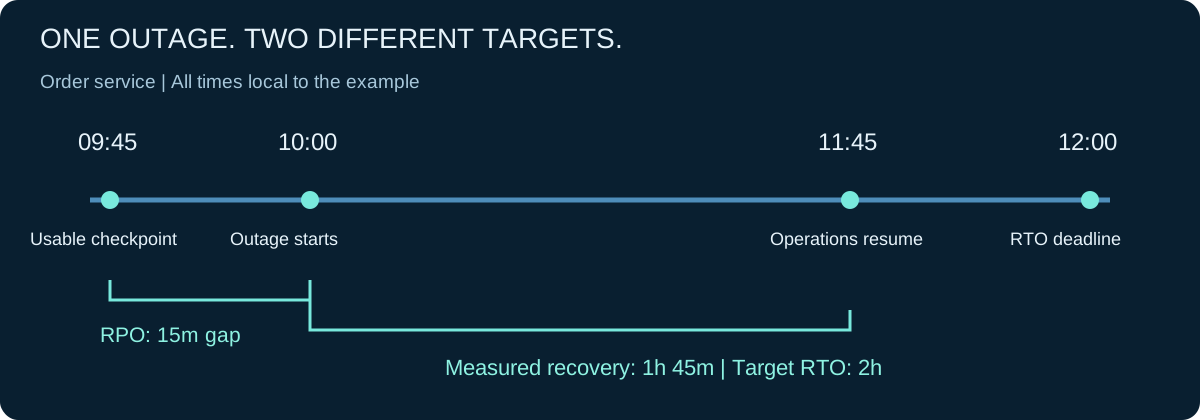
The latest isolated daily backup could be up to 24 hours old. If the standby checkpoints are unusable during a cyber incident, this fallback does not meet the 15-minute order RPO. That gap must be accepted, reduced through additional protected recovery points, or handled through a documented alternate process.
Critical assets and recovery order
Sample priorities keep dependencies ahead of the services that need them. Targets below require validation through a recovery exercise.
| Asset | Business function | Accountable owner | RTO target | RPO target | Dependencies / approach |
|---|---|---|---|---|---|
| Identity and DNS | Authentication, naming and emergency access | IT operations | 30 minutes | 5 minutes | Independent emergency access; secondary DNS; tested identity recovery |
| Order application and database | Receive and fulfill customer orders | Operations / application owner | 2 hours | 15 minutes | Identity, DNS, network, database replication and recovery-site capacity |
| Controlled document workspace | Access approved engineering instructions | Engineering / information owner | 8 hours | 4 hours | Identity, scoped recovery access, approved storage and data handling |
| Archive and historical reporting | Historical records and non-urgent reports | Records owner | 24 hours | 24 hours | Verified backup copies, keys and catalog |
From outage to resumed operations
The continuity plan keeps essential work going. The disaster recovery runbook restores systems. Owners sign off on safe, usable service rather than treating a running virtual machine as recovery.
| Time | Recovery activity | Owner | Acceptance evidence |
|---|---|---|---|
| 10:00 | Detect primary site outage; open incident record | Incident commander | Record actual outage start; establish a safe communication channel |
| 10:15 | Declare recovery; activate manual order intake | Business owner | Confirm customer impact and safe workarounds; preserve transaction log |
| 10:30 | Restore identity, DNS and recovery access | IT operations | Validate emergency credentials, least privilege, keys and secondary connectivity |
| 11:00 | Promote the validated 09:45 database checkpoint | Database owner | Fence primary writes; verify clean checkpoint and application consistency |
| 11:30 | Validate recovery service and reconcile manual orders | Application and business owners | Check record counts, transactions, permissions and external integrations |
| 11:45 | Approve resumed order processing | Business owner | Record measured RTO of 1h 45m and recoverable-data gap of 15m; confirm all acceptance checks |
| Later, after stabilization | Plan and execute controlled return to primary | Change owner | Approve reverse replication, data reconciliation, cutover, rollback and monitoring |
What a recovery exercise would prove
- Availability: Can staff access the recovery environment using tested identity, DNS, network paths and available licenses?
- Integrity: Are recovery points clean, decryptable and consistent across applications and databases?
- Business usability: Can an authorized user process an order and reconcile the manual queue?
- Timing: Measure detection, declaration, restoration, validation and business resumption from the outage timestamp.
- Return to normal: Test controlled failback, conflict handling, rollback and stakeholder communication.
A cyber scenario also requires containment and clean recovery validation before restoration. A site outage and ransomware incident can have different recovery paths and achievable times.
Examples of what you could receive
These completed samples show the shape of an engagement. The actual deliverables are tailored to the agreed scope, applications and business owners.
What must your organization recover first?
Share your critical services, dependencies and business deadlines.
Get in touch